

Discover Health Sharing Plans (HSP)

2023-09-04T13:25:27+00:00September 4th, 2023|Adults, Community, Direct Primary Care, Health Care, Public Health, Uncategorized|

Navigating Health Care Alternatives:

Health Sharing Plans and Direct Primary Care

Insurance costs are increasing and have become a growing source of stress for individuals and families.  Many are not aware there is another alternative—and it’s called health care sharing plans. Health sharing plans (HSP), also known as medical cost sharing, can save you and your family a lot of money on healthcare. We review the basics of these plans and explore how they differ from traditional insurance coverage.

WE are doing health care differently at Roots Health Direct Primary Care…..

Health Sharing Plans (HSP): How It Works

Members in an HSP “share” medical costs. As part of an HSP, you are responsible for paying an initial unshareable amount (IUA) each month (like a premium). There is also an “annual unshared amount” (like a deductible) that your medical expenses must exceed before the plan shares your expenses.

Health care sharing can be great for people who:

  • Are generally in good health
  • Are not eligible for a tax credit based on income
  • Lack access to insurance through an employer or government program
  • Only want/need catastrophic coverage
  • Can’t afford current health insurance premiums
HSP vs Health Insurance

The Pros:

  • HCP counts as insurance under the Affordable Care Act (ACA), even though they are not insurance. This allows for affordable healthcare benefits while avoiding the tax penalty for going uninsured.
  • HSP are provided at a much lower monthly cost.
  • The annual “unshared amount” is much, much lower than deductibles for insurance plans.
  • You have any choice of provider. There are no network requirements. If you pay out-of-pocket, health sharing plans reimburse your expense.

The Cons:

  • Health care sharing plans are not required to cover pre-existing conditions at the time of enrollment such as cancer, diabetes, or smoking. Those who have them may be declined membership or won’t have the conditions fully covered for a year or more.
  • Health care sharing also doesn’t typically cover the essential health benefits like wellness exams or mental health counseling.

HSP and Direct Primary Care work well together

The DPC will meet vast majority of a person’s primary health care needs and any urgent care needs for a low monthly fee without copays or deductibles. DPC will ensure access to high quality low cost laboratories, medications , and consultations with specialists. You receive higher quality care with better access to your physician without waiting.

Experience Comprehensive Care Now at Roots Health DPC

Making Health Your Priority in 2023: Tips for Success

2023-01-22T20:41:04+00:00January 16th, 2023|Adults, Community, Family Practice, Health Care, Membership, Mental Health|

The goal of becoming healthier is among the most popular resolutions. Many resolve to eat healthier and exercise regularly. These resolutions are great, but they do not address the way stress can sabotage our best efforts to live a healthy life. Emotional well-being underpins our success at achieving our health goals for 2023.

Goal setting is good, but the mindset work that builds the foundation for the path to success is what is most important. Living a healthy life is a journey, not a destination, and there are no “quick cures” when it comes to health and well-being. Failure can cause impatience and it is necessary to remember that you will succeed… if you don’t expect overnight success.

At Roots Health DPC we provide a system and support to ensure that you achieve your health and wellness goals. We know that healthy living is the foundation for a successful happy productive life.


Use these tips to help ensure you follow through with prioritizing your health in 2023:

Stay in Touch

Connect with friends in person. It’s good for your health to maintain friendships. In general, a lack of social bonds can damage your health as much smoking, obesity, and high blood pressure.

Surround yourself with people who are making their personal health and wellness their priority. In a technology-fixated era, it’s never been easier to stay in touch, so fire up your favorite social media and then follow up with in-person visits.

Plan for bumps in the road: A support system can help. We thrive with social interaction and support. Surround yourself with like-minded people looking to prioritize their health and wellness this year. It is important to have someone there on a regular basis to get you through those rough times.

Manage Your Stress

Stress, in small doses, can actually be helpful for short periods. But chronic stress can increase your risk of—or worsen—anxiety, depression, diabetes, heart disease, and more. The best way to manage stress is to control the factors you have agency over:

  • Get enough sleep
  • Exercise
  • Ensure you are eating well
  • Spend intentional time relaxing away from stressors

Relaxation, sleep, socializing, and taking vacations are things we all deserve and owe to ourselves for our health and well being in 2023. Finding healthy ways to cope with the stress in your life is imperative to your well-being.

Cut Back on Alcohol

Drinking alcohol in excess can increase risk for depression, increase memory loss, and increase hot flash symptoms in perimenopausal women. Heavy chronic drinking increases your risk for liver and heart disease, stroke, mental deterioration, and even cancers of the mouth, throat, liver, and breast.

If cutting back on alcohol to a couple of drinks per week seems to be difficult, consider reaching out for help.

Get More Sleep

You probably already know that a good night’s rest can do wonders for your ability to function on all cylinders. But sleep is more beneficial to your health than you might realize. A lack of sleep has been linked to a greater risk of obesity and type 2 diabetes.

Aim to get quality sleep and more of it by exercising good sleep habits. These habits can include actions such as:

  • Going to bed and waking up at consistent times daily
  • Having a comfortable bedroom atmosphere (i.e., one that is dark, quiet, and relaxing)
  • Getting exercise during the day

It’s common for people to make New Year’s resolutions, but it’s also common for people to break them. Fortunately, there are resolutions you can make with ways that can help you stick to them. At Roots Health DPC, we take the time to understand your unique health goals and work with you to address obstacles to your success. We invite you to join us and let us help you achieve your health and wellness goals in 2023.

Mondays with your MD – Getting to the root of your healthcare concerns

2022-10-08T18:48:36+00:00October 3rd, 2022|Community, Family Medicine, Family Practice, Health Care, Membership|

Are you frustrated with the existing health care system? Is your doctor treating your individual symptoms but not helping you find the root cause for the constellation of symptoms you have? Are you wondering if your health care needs might require an integrative approach?

Roots Health DPC provides a patient-centered approach that engages the whole person; nourishes the mind, body, and spirit; and encourages the conscious creation of personal health and wellness. Patients have constant direct access to board-certified medical care with ample time to fully evaluate and treat the root cause of symptoms.

Did you know that the average length of time spent in an office visit to cover patient concerns and circumstances is 7 minutes in the traditional insurance-based health care model? That’s right… 7 minutes! It is no small wonder that the typical health care experience feels piecemeal and rushed. You would not expect your mechanic to diagnose, let alone treat, your car problem in 7 minutes…. so why do we accept this substandard care for our own health and well-being?

At Roots Health DPC, we know that your health is the most important thing. It is the foundation for living life on your terms.

Why should you consider direct primary care for your health care?

Quality time
Quality time to understand your health care needs with your physician and create an individualized health care plan. We focus on the whole patient as a unique individual –taking into account each element of a person’s health, environment, and lifestyle.

Communication
Communication with your board-certified physician that is easy and ongoing making it simple to adjust the plan as necessary to meet your health care needs. Unlimited physician access and visits… in office and virtual

No Waiting. No Copays. Ever.

Affordable Transparent Pricing.

A low monthly membership fee provides unlimited direct access to your physician to work with you as a team to obtain and maintain your optimal health and well-being. Steep discounts on labs, medications, supplements, and imaging.

If you are looking for a board-certified physician that you trust to look at the whole picture and get to the root of your health concerns and help you build a healthier life…. consider joining us at Roots Health DPC. Schedule a Free Meet and Greet with Dr Diaz today.


Sign up here to make sure you never miss a “Mondays with your MD” post


    Mondays With your MD – New Covid Vaccine: Bivalent Boosters

    2022-09-25T19:22:53+00:00September 24th, 2022|Community, Coronavirus, Family Practice, Health Care, Pandemic, Public Health, Vaccine|

    The new bivalent booster offers better protection against recently circulating COVID-19 variants and helps restore waning protection from previous vaccination. It offers broader protection for new variants. People must complete the primary series (original monovalent vaccines) before getting a bivalent booster dose.

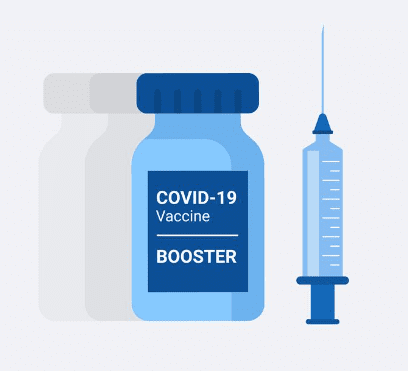
    covid-19-booster

    Who should get the new booster?

    • People 12 years and older should receive the updated Pfizer or Moderna (bivalent booster)
      This includes people who have received all primary series doses and people who have received the original (monovalent) boosters
    • At this time children ages 12-17 years can only receive the updated Pfizer bivalent booster.
    • Children under 12 years do not get a bivalent booster yet.

    What is considered “Up to Date” with all these boosters?

    Once you have completed the covid-19 vaccine primary series and received he most recent booster dose that is recommended

    When should I get the new booster? Which brand should I get?

    The new bivalent booster can be given at least 2 months or more after your last COVID vaccine. The monovalent booster should no longer be given to anyone 12 years of age and older.


    It is fine to get a booster from a different brand than the primary series or previous boosters. For example, if your primary series was Moderna you can get the Pfizer bivalent booster.

    What about kids under 12 years old?

    At this time, children under 12 years old will NOT receive the new bivalent booster dose although this is likely to change in the future.

    Children 5 years – 11 years who received Pfizer for their primary series should still get a monovalent booster 5 months after the last dose of the primary series.

    Children 5 years – 11 years who got Moderna for their primary series do not get a booster at this time.

    Children 6 months – 4 years should get all COVID-19 vaccination primary series doses.

    At Roots Health DPC we help our patients navigate the ever-changing COVID-19 guidelines around
    testing, treatment, and prevention. Set up a FREE “Meet and Greet” with Dr Diaz today.


    Sign up here to make sure you never miss a “Mondays with your MD” post


      Mondays with your MD – Covid … Again? What you need to know

      2022-09-12T18:57:23+00:00September 12th, 2022|Community, Coronavirus, Covid-19 Testing, Pandemic, Public Health, Vaccine|

      There seem to be more cases of COVID circulating in our community now… so I thought I would share the most common questions and concerns I hear from patients.

      My family member has COVID. How often do I need to test myself?

      • If you develop symptoms it is recommended to test immediately.
      • If you have symptoms and your rapid test is negative it is recommended you obtain a PCR test.
      • If you do not have symptoms, you should wait at least 5 days after your exposure to do testing.
      • If you are vaccinated and do not have symptoms you do not need to isolate before testing.

      Can I really get COVID again? I already had it.

      Yes. Everyone 12 years of age and older can receive an updated COVID booster which targets the new COVID variants. Although your disease may not be as severe, you can still catch COVID and pass it to others who may be more vulnerable.

      My COVID test is positive… still.

      Some patients believe they need a negative test to return to work. The truth is that once you have a positive test there is no reason to repeat a test. The isolation period is 5 days and can last up to 10 days depending on the severity of your illness. If your isolation ends on day 5, you should intentionally wear a mask whenever you go in public until the full 10 days has elapsed.

      What is Paxlovid and does it work?

      Paxlovid is one of the medications used to treat COVID. It is highly recommended for those at risk for disease progression and it significantly decreases the severity of the disease. Do not delay seeking care as this treatment must be started within days of when you first develop symptoms to be effective.

      When you have questions about urgent health concerns, you want accessible advice from your physician. Wouldn’t it be great if you could just text your doctor and ask? At Roots Health DPC that is how we provide medical care! We are available to our patients by phone, email, and text anytime. Schedule a FREE “Meet and Greet” at Roots Health DPC to find out more.


      We are now accepting new patients and would love the privilege of serving you in our clinic.

      Mondays with Your MD: Gun Violence – A Public Health Epidemic

      2025-08-04T17:32:30+00:00May 29th, 2022|Community, Public Health|

      Firearms are the leading cause of death in children in the United States. Firearm deaths are completely preventable and occur at a rate more than 5x higher than drownings.


      Prevention is key…
      As with any health-related problem, prevention through education is a critical component. Firearms are present in 1/3 of households with children.
      • The best way to keep children safe is to NOT have a gun in the home.
      • If it is necessary to keep a gun in the home safe storage is critical. Guns should be kept unloaded and ammunition should be stored separately. Both should be locked and inaccessible.
      • Parents can speak to caregivers in homes where young children are visiting about guns in the homes where they play.
      • Talk to older kids about guns and safety.

      In almost every documented case of active shooters, there were warning signs. In 4 out of 5 school shootings at least one other person had knowledge of attackers plan but failed to report it.

      9 critical warning signs of violence:

      1. Suddenly withdrawing from friends, family and activities (including online or via social media)
      2. Bullying, especially if targeted towards differences in race, religion, gender or sexual orientation
      3. Excessive irritability, lack of patience, or becoming angry quickly
      4. Experiencing chronic loneliness or social isolation
      5. Expressing persistent thoughts of harming themselves or someone else
      6. Making direct threats toward a place, another person, or themselves
      7. Bragging about access to guns or weapons
      8. Recruiting accomplices or audiences for an attack
      9. Directly expressing a threat as a plan

      Advocacy to protect children from gun-violence needs to occur a national level to have meaningful impact.

      States with stronger gun laws have less gun violence overall. However, Chicago borders states outside of IL with fewer gun control laws.

      Basic measure such as stopping assault weapon sales and advocating for high-capacity magazine limits, alongside ammunition regulation, and required background checks are all important. Increasing gun manufacturer liability is also critical.

      Visit https://www.everytown.org/ to learn more about how you can work towards limiting gun violence.

      Mondays with Your MD: Skin Cancer Awareness Month

      2025-08-04T17:32:26+00:00May 15th, 2022|Community, Families, Family Medicine, Special Offer|

      Summer is almost here…. and with it comes lots of outdoor activities. Protecting your skin from the sun is imperative. Did you know that skin cancer is the most common type of cancer?

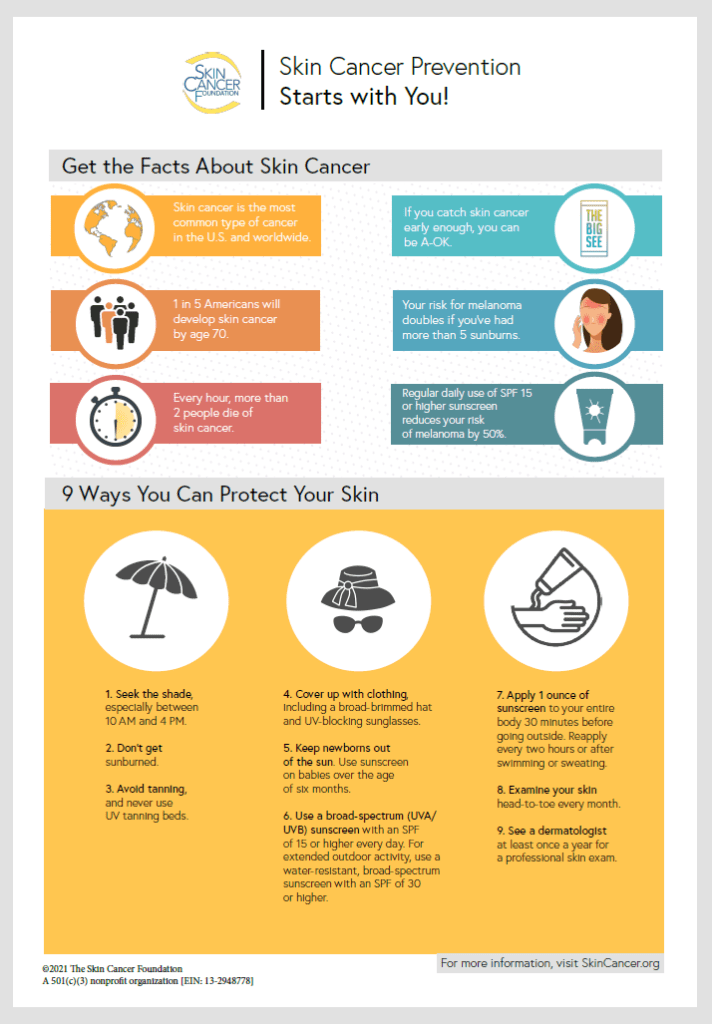
      skin-cancer-prevention-facts

      The good news is that skin cancer can be prevented and it can almost always be cured… when it’s found and treated early.

      Simple Skin Cancer Prevention Tips:

      -Seek the shade between 10am-4pm
      -Do NOT get a sunburn
      -Use broad spectrum sunscreen SPF 30 or higher and reapply after 2hours
      -Examine your skin once a month


      Subscribe to our newsletter to learn more and get FREE SKIN CANCER SCREENING

      The Pandemic. Deferred wellness. Navigating health today.

      2025-08-04T17:32:17+00:00May 8th, 2021|Community, Copays, Deductibles, Direct Primary Care, Family Medicine, Membership, Pandemic, Telemedicine, Urgent Care|

      As we pass one year since the pandemic started, it is time to take stock of our overall health and what it means to us as individuals.  It’s important to note the collateral effects that the COVID-19 pandemic has had on our individual health as well as the overall wellness of our community.  Many avoided or delayed care (both urgent and routine) to lower the risk of acquiring COVID-19.   We now have evidence that this shift has led to delayed diagnosis and treatment which results in poor outcomes.

      While we can celebrate some success as the number of vaccinated individuals increases in the United States, we still struggle with effects of social isolation and the surge of mental health problems that accompany it.

      Prior to the pandemic, it was common for patients to avoid the “hassle” of the traditional health care system. Patients disliked the “big production” around getting an appointment and waiting to be seen as well as the amount of time and energy spent to engage with the insurance-based model of care. Often patients delayed care because the cost was not transparent and surprise billing was never popular.  Between copays, deductibles and out-of-pocket maximums most people have no idea what costs to expect when they seek the care that is recommended.

      The pandemic has accentuated the difficulties of getting care… we have witnessed that our health care system is beyond broken.  It does not serve patients and the time for change is past due.

      What if getting care was as easy as scheduling online and speaking directly to your doctor via phone text or email whenever needed?  What if there was no “hassle” to get an appointment and no wait to see your doctor?  The Direct Primary Care (DPC) model has made this a reality.  Your physician is easily accessible with time to address all your health concerns.  DPC is the future of health care and is championed by physicians around the country dedicated to doing what is best for their patients.  DPC takes away the “pain” of seeing the doctor.  It emphasizes the value of the patient-physician relationship and creates space for shared decision-making around health and wellness.  DPC provides excellent care, transparent pricing, and unparalleled accessibility.

      During the pandemic, DPC patients had unlimited access to their physician.  They were engaged in healthcare prevention and maintenance conversations with their physicians.  They received superior care by having direct communication with their physician.  There were no “surprise” bills because DPC membership fees are transparent and extremely affordable.

      As with anything difficult, we can always find a silver-lining… and we must if we want to continue to grow and improve. The pandemic has made the case for DPC.  We all deserve better health care. The foundation for improved health outcomes lies in the rebuilding of a solid physician-patient relationship.  How we get through it all… will always depend on… who we get through it all with.

      >>LEARN MORE ABOUT ROOTS HEALTH DPC<<

      >>Click here to call ROOTS now 708-613-7916<<

      COVID 19 VACCINE: Where do I sign up?

      2025-08-04T17:32:15+00:00February 4th, 2021|Adults, Community, Coronavirus, Pandemic, Vaccine|

      COVID VACCINE INFORMATION.

      Illinois entered phase 1b for vaccinations at the end of FEB
      INCLUDES 65+ AND OVER, FIRST RESPONDERS, EDUCATION WORKERS LIKE TEACHERS AND SUPPORT STAFF, CHILDCARE WORKERS, GROCERY STORE EMPLOYEES, POSTAL SERVICE WORKERS, AND MORE.

      If you are unsure if you are in Tier 1B, please *SEE COMPLETE LIST BELOW from IDPH website.

      We know many of you desire vaccination but are unable to obtain an appointment. This is slowly improving and we will update the following information as available. For now, we have compiled a list of the places where you can sign up and check for an appointment.

      New IDPH Vaccine Appointment Call Center
      The Illinois Department of Public Health launched a Call Center to help bridge technology barriers and assist with vaccine appointments. It is to help assist people who do not have access to or who have difficulty navigating online services in making appointments to receive the COVID-19 vaccine.
      – The Vaccine Appointment Call Center is open 7 days a week, 6am-midnight.
      – The phone number is 833-621-1284.
      – There are approximately 500 agents answering calls with the ability to expand during peak periods. The call center has English and Spanish speaking call agents with the availability for translation into other languages.

      Vaccine Finder
      https://vaccinefinder.org/
      – The Vaccine Finder website allows you search for Vaccine Providers by zip code across the country
      – It will state if that location has vaccine in stock or not and direct you towards registering for appt

      ZocDoc Appointment finder
      https://www.zocdoc.com/vaccine/
      – This is an additional way to schedule vaccine appointments through participating providers by Zip Code

      Walgreens has opened limited vaccination appointments through this link
      https://www.walgreens.com/findcare/vaccination/covid-19

      Albertson’s Companies including Jewel have opened limited vaccination appointments through this link
      https://mhealthappointments.com/covidappt

      IL Department of Public Health (ILDPH) at the following link
      https://covidvaccination.dph.illinois.gov/

      Cook County COVID-19 Community Vaccination Program
      https://vaccine.cookcountyil.gov/

      If you have a provider at a local medical center, we recommend you call them to determine when the vaccine will be available for you. If you are a Loyola or PCC Wellness patient this may already be available to you through your medical center.

      Roots Health DPC does not have access to the vaccine, but we are working on partnering with local community organizations to ensure access.

      Please note: after vaccination we will still need to practice social distancing and wearing masks. A vaccine that is 95% effective means that about 1 out of 20 people who get it may not have protection from getting the illness.


      *LIST OF TIER 1B CANDIDATES (per IDPH guidelines)
      Phase 1B:

      Persons aged 65 years and older
      Frontline essential workers, are defined as those workers who are essential for the functioning of society and are at highest risk of exposure, including the following:
      First responders: Firefighters (including volunteers), Law Enforcement Officers (LEOs), 911 Dispatch (Public Safety Answering Point – PSAP), Security Personnel, School Officers. (EMS personnel are considered under Phase 1a).
      Corrections Officers/Inmates: Jail Officers, Juvenile Facility Staff, Workers Providing In-Person Support, Inmates.
      Food and Agriculture Workers: Processing, Plants, Veterinary Health, Livestock Services, Animal Care.
      Postal Service Workers
      Manufacturing Workers: Industrial production of goods for distribution to retail, wholesale or other manufacturers.
      Grocery Store Workers: Baggers, Cashiers, Stockers, Pick-Up, Customer Service.
      Public Transit Workers: Flight Crew, Bus Drivers, Train Conductors, Taxi Drivers, Para-Transit Drivers, In-Person Support, Ride Sharing Services.
      Education Workers (Congregate Child Care, Pre-K through 12th grade): Teachers, Principals, Student Support, Student Aids, Day Care Workers.
      Shelters/Adult Day Care: Homeless Shelter, Women’s Shelter, Adult Day/Drop-In Program, Sheltered Workshop, Psycho-Social Rehab.

      COVID-19 TESTING – Education and Information

      2025-08-04T17:32:13+00:00December 13th, 2020|Adults, Community, Coronavirus, Covid-19 Testing, Families, Pandemic|


      EVERYTHING YOU NEED TO KNOW TO KEEP YOURSELF AND YOUR LOVED ONES SAFE

      We all want quick COVID test results, understandably. But what we need are accurate results.  The worst-case scenario for my patients would be a false sense of security from a negative test when they, in fact, have COVID-19 and could harm the ones they love.  This is why public education around testing and results is so important.

      At Roots Health DPC, we are committed to sharing information about COVID testing so that you can make informed decisions regarding testing and results.  Not all tests are created equal.  Below, we review what tests are used to detect whether someone has an active COVID infection, when additional testing might be necessary, and best practices for our patients when it comes to “rapid testing.”  

      Types of COVID-19 Testing:

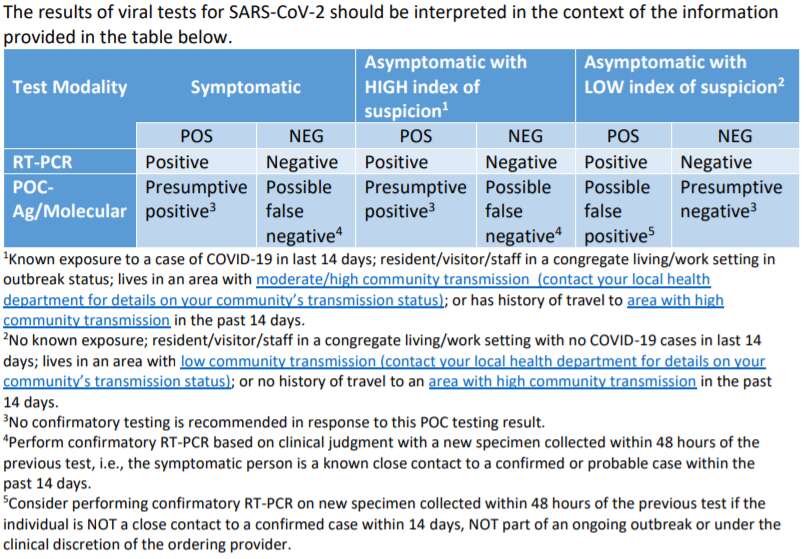
      The most accurate, “gold standard” test for clinical diagnostic detection of COVID-19 (SARS-CoV-2) is Real-Time Reverse Transcriptase Polymerase Chain Reaction (RT-PCR) more commonly known as “PCR testing”.  Other tests are available and include rapid point-of-care (POC) molecular test and the POC antigen tests.  POC tests, commonly known as “rapid tests,” have a higher probability of missing an active infection and it may be necessary to confirm rapid negative test results with a PCR test.

      When might it be necessary to confirm a negative rapid test result with a PCR test?

      In certain instances, a negative test result in a rapid test should be followed up by a PCR test.  For example, if the result of the rapid POC test is inconsistent with the patient’s symptoms.  In other words, if a patient has active COVID symptoms but receives a negative result, that person should proceed to PCR testing.

      There are other instances when it is recommended to proceed to PCR confirmation of a negative rapid test.  For example, when you have been exposed to a known positive case for more than 15 minutes within 6 feet it is recommended to obtain testing.  If your rapid test is negative, PCR confirmation would be best practice.   

      Given what we know about the decreased accuracy of rapid testing, what are the most appropriate uses for rapid testing? 

      Rapid testing is extremely useful when it is positive.  However, it will not change the plan for the patient.  Patients who are symptomatic and positive will be instructed to isolate for a minimum of 10 days from the onset of symptoms while they are contagious to others.  Patients who are asymptomatic but have had a “close contact” exposure will be instructed to quarantine for 14 days from the date of exposure.   

      Rapid testing may be an appropriate test for those who have no symptoms and no exposure.  For example, some people are required to obtain a negative COVID-19 test prior to travel.    

      Roots Health DPC is committed to providing accurate COVID-19 testing information to you and your loved ones.

      There are many different tests being offered with a constantly changing landscape of locations and availability.  We understand that this can be overwhelming. It is our hope that this resource can help you navigate what type of test is best for you and your loved ones.  Wherever you choose to test, please makes sure you know what type of test is being offered and have your questions answered before testing.  

      At Roots Health DPC, we currently offer PCR testing with a return time of 48-72 hours.  All persons who test with Roots Health DPC are provided relevant and clear CDC recommendations including information on what to do while waiting for your test result, understanding the difference between quarantine and isolation, understanding how to manage COVID-19 symptoms at home, and learning how best to prevent the spread in your home if you have COVID-19.

      If we can be of service or answer any questions, please feel free to reach out to us directly at 708-613-7916.  

      >>Click here to schedule a COVID-19 test<<

      >>LEARN MORE ABOUT ROOTS HEALTH DPC<<

      covid-CDC-testing-chart
      No waiting. Healthcare delivered when you need it.
      Go to Top